Tungsten Copper Alloy Selection Guide
Tungsten copper alloy is pseudo-alloy composed of tungsten and copper, typically manufactured through powder metallurgy and copper infiltration. It combines tungsten's high melting point, high hardness, and low coefficient of thermal expansion with copper's good electrical and thermal conductivity. Different tungsten-to-copper ratios result in different density, hardness, electrical conductivity, thermal conductivity, and coefficient of thermal expansion. These properties make tungsten copper alloy suitable for high-voltage switch contacts, resistance welding electrodes, Electrical Discharge Machining (EDM) electrodes, electronic packaging heat sinks, and aerospace components exposed to high temperatures. CTIA's selection guide for tungsten copper alloy introduces material properties, common grades, and material selection criteria for different applications, helping users select suitable tungsten-to-copper ratios, and product specifications according to actual operating conditions.
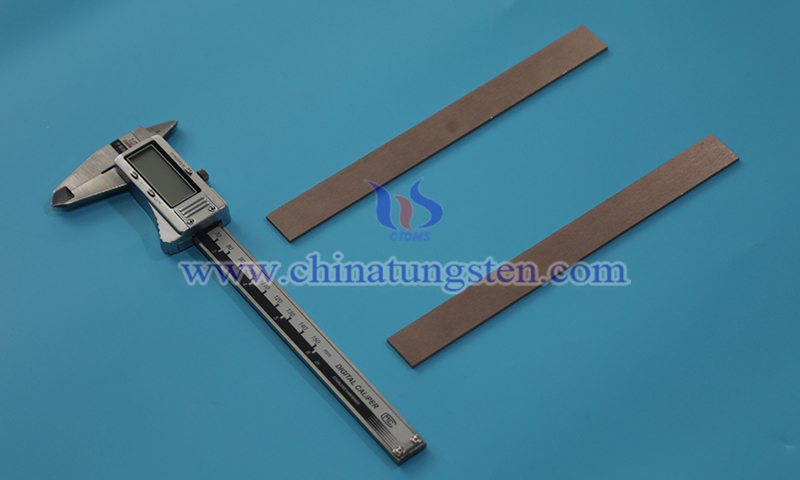
CTIA's Selection Guide of Tungsten Copper Alloy
1. How to Select Suitable Tungsten Copper Alloy?
Selection of tungsten copper alloy depends on product application, operating condition, and performance requirement, mainly involving the following step:
(1) Clarify Application Scenario: Identify whether product is intended for high-voltage switch, resistance welding, Electrical Discharge Machining (EDM), electronic packaging, or other equipment, and evaluate operating parameter such as current, temperature, contact pressure, and surrounding medium.
(2) Analyze Primary Performance Requirement: Based on operating mode of product, pinpoint critical challenge to address, such as arc erosion, contact wear, high-temperature deformation, heat dissipation, or thermal expansion mismatch, establishing clear material selection priority.
(3) Define Key Performance Parameter: According to application demand, specify critical parameter such as electrical conductivity, thermal conductivity, hardness, arc erosion resistance, and coefficient of thermal expansion, distinguishing primary requirement from secondary requirement.
(4) Select Tungsten-to-Copper Ratio: Compare performance data across different tungsten-to-copper ratio (grade), and select material meeting operating demand while balancing electrical conductivity, thermal conductivity, erosion resistance, and machinability.
(5) Specify Product Structure and Dimension: Based on equipment assembly method and load condition, choose between integral and composite structure, and clarify product geometry, dimension, tolerance, and precision machining requirement.
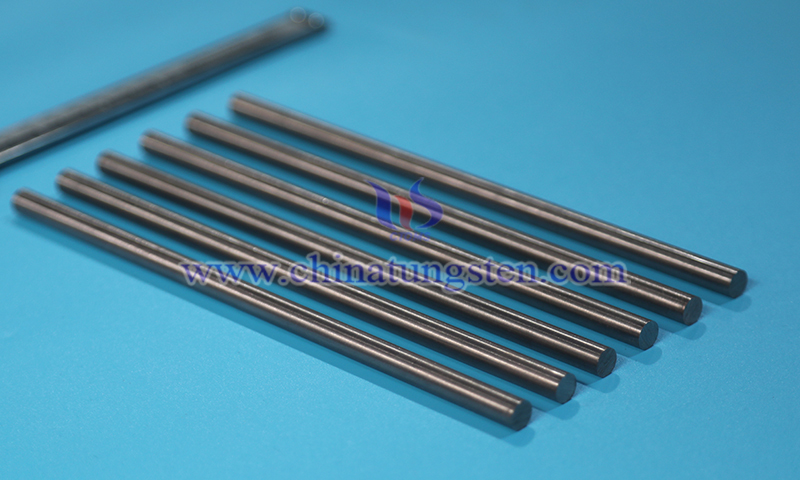
2. What Property Should Be Evaluated When Selecting CTIA's Tungsten Copper Alloy?
The selection of CTIA's tungsten copper alloy requires matching product application with operating condition, focusing on evaluating the following performance property:
(1) Electrical Conductivity: Governs current-carrying capacity and resistive loss of material. Tungsten copper alloy with higher copper content typically delivers superior electrical conductivity, suitable for component demanding efficient current transmission.
(2) Hardness: Determines compressive strength, deformation resistance, and wear resistance of material. Tungsten copper alloy with higher tungsten content typically exhibits greater hardness, suitable for component subjected to heavy mechanical load.
(3) Arc Erosion Resistance: Minimizes melting, evaporation, and material loss under arc exposure, serving as critical performance criterion for arc-switching component such as high-voltage switch contact.
(4) Thermal Conductivity: Regulates heat transfer and dissipation efficiency of material, proving essential for electronic packaging, heat dissipation baseplate, and high-temperature conductive component.
(5) Coefficient of Thermal Expansion: Dictates thermal expansion matching between material and chip, ceramic substrate, and adjacent metal part, directly influencing interface thermal stress during temperature fluctuation.
(6) Density: Defines product mass and volume for given dimension, varying directly with tungsten-to-copper ratio and proving particularly critical for counterweight and component facing strict space or weight constraint.
(7) Machinability: Impacts ability to achieve complex geometry, tight dimensional tolerance, and surface finish requirement, while machining state and precision grade should also be specified.
3. Grades and Performance Comparison of CTIA's Tungsten Copper Alloy
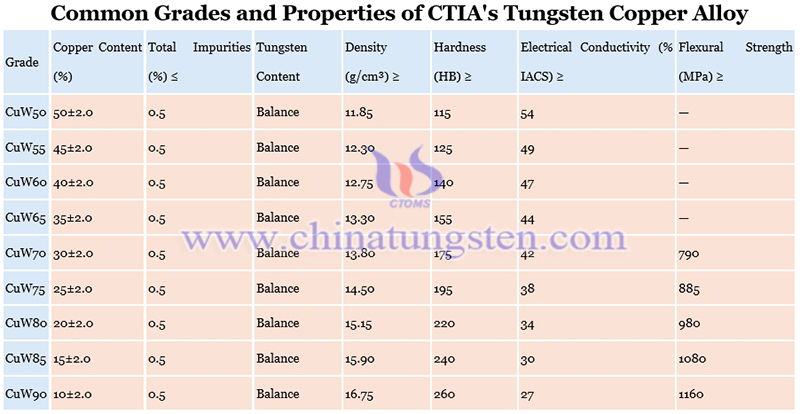
Tungsten copper alloy grades are generally designated according to tungsten content. For example, CuW70 indicates approximately 70% tungsten and 30% copper. Common CTIA tungsten copper alloy grades include CuW50, CuW55, CuW60, CuW65, CuW70, CuW75, CuW80, CuW85, and CuW90. These grades differ in copper content, density, hardness, electrical conductivity, and flexural strength. Common grades and properties of CTIA's tungsten copper alloy are shown in the picture below:
4. How to Select CTIA's Tungsten Copper Alloy for Different Applications?
(1) High-Voltage Switch Electrical Contact: Prioritize arc erosion resistance, welding resistance, electrical conductivity, and current-breaking performance, determining material specification based on voltage rating, breaking current, and interrupting medium.
(2) Resistance Welding Electrode: Focus on electrical conductivity, anti-sticking property, wear resistance, and high-temperature softening resistance, tailoring performance requirement based on workpiece material, welding current, and duty cycle.
(3) Electrical Discharge Machining (EDM) Electrode: Evaluate electrode wear rate, discharge stability, machining efficiency, and surface finish, selecting material grade according to workpiece material and machining accuracy.
(4) Electronic Packaging and Heat Sink: Match coefficient of thermal expansion with chip and ceramic substrate alongside high thermal conductivity for component such as chip carrier, packaging substrate, heat dissipation baseplate, and heat sink.
(5) Aerospace High-Temperature Component: Ensure high-temperature structural stability, thermal shock resistance, and ablation resistance for part such as rocket motor nozzle throat insert, jet vane, and other high-temperature erosion-resistant components.
5. Selection Considerations for CTIA's Tungsten Copper Alloy
(1) Avoid Blindly Pursuing High Tungsten Content: Increasing tungsten content typically reduces electrical and thermal conductivity while raising machining difficulty and material cost, so composition ratio should align with actual operating condition.
(2) Account for Actual Operating Condition: Current load, energizing duration, operating temperature, contact pressure, and surrounding medium such as air, SF₆, or vacuum all dictate material performance requirement.
(3) Adopt Composite Structure Where Appropriate: Component such as resistance welding and electrical upsetting part can utilize composite structure pairing copper substrate with tungsten-copper working face, providing erosion resistance at contact zone while preserving overall electrical conductivity.
(4) Factor in Surface Finish and Joining Process: Surface treatment such as nickel plating and gold plating should be chosen based on corrosion protection, bonding, and assembly requirement; electronic packaging part must also ensure compatibility with joining process such as brazing and soldering.
CTIA GROUP has specialized in tungsten copper alloy manufacturing for nearly 30 years, with rich experience in powder metallurgy and precision machining. CTIA provides material ratio selection, grade matching, structural design, sample trial production, and product specification customization based on working condition and performance requirement across high-voltage switch, resistance welding, Electrical Discharge Machining (EDM), electronic packaging, and aerospace application.
For any inquiry, please contact tungsten copper manufacturer: CTIA GROUP
Email: sales@chinatungsten.com
Tel: 0086 592 5129696 / 0086 592 5129595
Website: tungsten-copper.com
WeChat: