Tungsten Copper Alloy vs. Tungsten Silver Alloy
Tungsten copper alloy (WCu) and tungsten silver alloy (WAg) are both composite materials consisting of refractory tungsten skeleton and conductive copper or silver phase, respectively. They offer high hardness, heat resistance, and arc erosion resistance, making them widely used in electrical contacts, switchgear, and electrical machining components. The main differences between tungsten copper alloy and tungsten silver alloy lie in material composition, electrical and thermal conductivity, density, anti-welding performance, and manufacturing costs. These differences also determine their material ratio design and product applications.
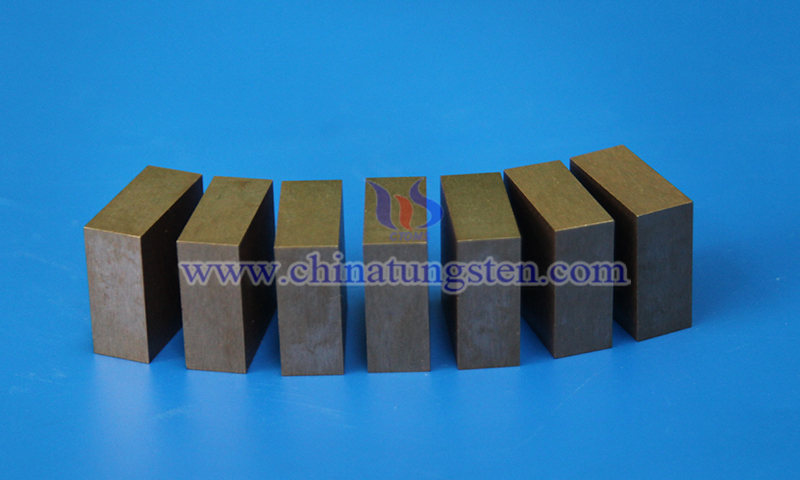
Differences Between Tungsten Copper Alloy and Tungsten Silver Alloy
1. Tungsten Copper Alloy vs. Tungsten Silver Alloy: Material Composition and Ratios
Tungsten copper alloy consists of tungsten and copper, while tungsten silver alloy consists of tungsten and silver. The tungsten phase mainly provides hardness, wear resistance, and arc erosion resistance, while the copper and silver phases provide electrical and thermal conductivity. Both materials are generally manufactured through powder metallurgy, involving powder pressing, skeleton sintering, and metal infiltration.
Common tungsten copper alloy ratios include W50Cu50, W70Cu30, W75Cu25, and W80Cu20. Common tungsten silver alloy grades include AgW50, AgW60, AgW70, and AgW75. CTIA adjusts tungsten copper ratios according to product performance requirements and operating conditions. Higher tungsten content generally improves hardness and wear resistance but reduces electrical conductivity.
2. Tungsten Copper Alloy vs. Tungsten Silver Alloy: Electrical Conductivity and Density
Silver has higher electrical conductivity than copper, so tungsten silver alloy generally offers greater current-carrying capacity, making it suitable for electrical components requiring high current capacity and low contact resistance. Tungsten copper alloy also provides good electrical conductivity while balancing current transmission, mechanical strength, and arc erosion resistance.
Silver has density of approximately 10.49 g/cm³, compared with approximately 8.96 g/cm³ for copper. At the same tungsten content, tungsten silver alloy generally has higher theoretical density than tungsten copper alloy. Actual product density also depends on material ratio, porosity, and densification, so the density of the constituent metals alone cannot determine the final product density. CTIA selects suitable tungsten copper ratios according to target density and electrical conductivity requirements to meet the needs of different electrical components.
3. Tungsten Copper Alloy vs. Tungsten Silver Alloy: Thermal and Mechanical Properties
Silver has higher intrinsic thermal conductivity than copper, giving tungsten silver alloy good potential for heat transfer. Tungsten copper alloy also offers good thermal conductivity, making it suitable for electrical contacts and thermal management components.
The hardness and wear resistance of both materials are mainly affected by tungsten content and microstructure. Increasing tungsten content generally improves hardness and wear resistance but reduces the proportion of the conductive phase. CTIA controls powder particle size, sintering quality, and copper infiltration to adjust the microstructure and density of tungsten copper alloy, thereby influencing its thermal conductivity, hardness, and wear resistance.
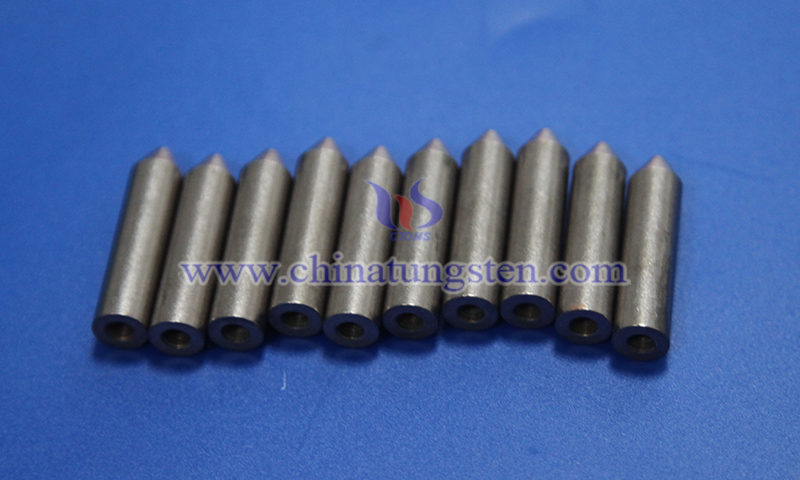
4. Tungsten Copper Alloy vs. Tungsten Silver Alloy: Arc Erosion Resistance and Anti-Welding Performance
Tungsten has high melting point, which is a key factor contributing to the arc erosion resistance of both tungsten copper alloy and tungsten silver alloy. Tungsten copper alloy offers good arc resistance and mechanical strength, making it commonly used in high-voltage switch contacts, vacuum electrical contacts, and electrical machining electrodes.
Tungsten silver alloy combines tungsten's arc resistance with silver's electrical conductivity, offering good anti-welding performance. It is commonly used in circuit breakers, high-current switches, and contactor contacts. The actual performance of both materials depends on tungsten content, contact pressure, arc energy, and contact structure. Their advantages should therefore be evaluated according to specific operating conditions rather than compared in isolation.
5. Tungsten Copper Alloy vs. Tungsten Silver Alloy: Application Comparison
Tungsten copper alloy is mainly used in high-voltage switch contacts, vacuum electrical contacts, Electrical Discharge Machining (EDM) electrodes, resistance welding electrodes, and electronic packaging heat sinks. It is suitable for components requiring a combination of mechanical strength, electrical conductivity, and arc erosion resistance.
Tungsten silver alloy is mainly used in circuit breaker contacts, high-current switch contacts, relay contacts, and contactor contacts. It is suitable for electrical components requiring high electrical conductivity, low contact resistance, and good anti-welding performance.
6. Performance Comparison of Tungsten Copper Alloy and Tungsten Silver Alloy
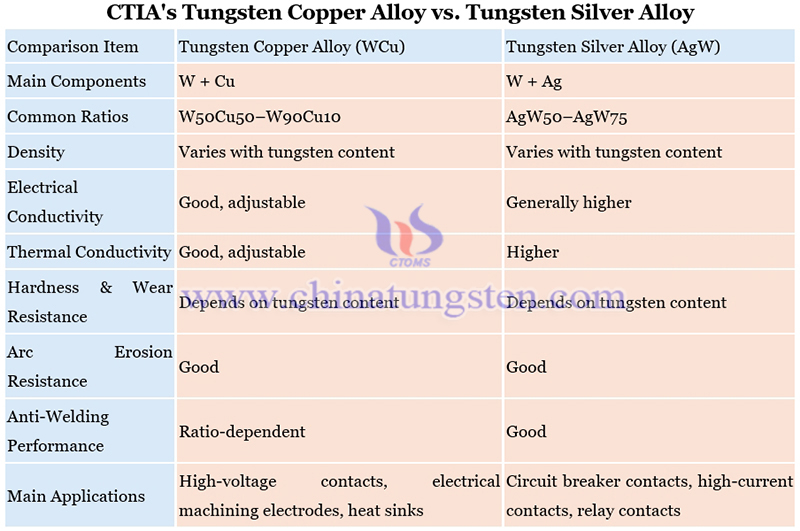
The main differences between the two materials involve their conductive phases, density, electrical and thermal conductivity, and typical applications. Their key characteristics are shown in the picture below:
CTIA GROUP has specialized in tungsten copper alloy manufacturing for nearly 30 years, possessing rich experience in powder metallurgy and precision machining. CTIA offers tungsten copper product in various ratio and specification, and provides customized solution including material selection, structural design, and precision machining tailored to application characteristic of electrical contact, switchgear, and electrical machining component.
For any inquiry, please contact tungsten copper manufacturer: CTIA GROUP
Email: sales@chinatungsten.com
Tel: 0086 592 5129696 / 0086 592 5129595
Website: tungsten-copper.com
WeChat: