Tungsten Copper Alloy vs. Molybdenum Copper Alloy
Tungsten copper alloy (WCu) and molybdenum copper alloy (MoCu) are both composite materials consisting of refractory metal matrix and copper as the electrically and thermally conductive phase. They are widely used in electrical equipment, electronic packaging, and thermal management. Their main difference lies in the base metal, which results in variations in density, melting point, and mechanical properties. Tungsten copper alloy has higher density and generally offers greater hardness and stronger arc erosion resistance, while molybdenum copper alloy has lower density and offers better weight reduction. The thermal conductivity and coefficient of thermal expansion of both materials can be adjusted by changing the copper content. Their actual properties depend on material composition and manufacturing processes.
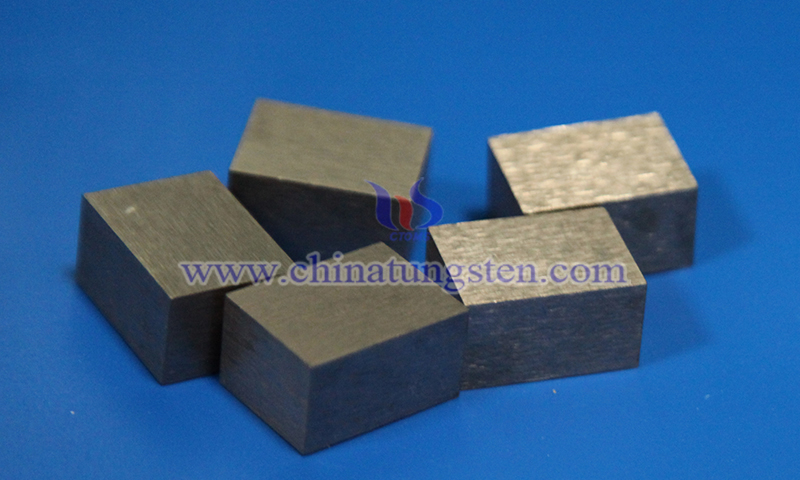
Differences Between Tungsten Copper Alloy and Molybdenum Copper Alloy
1. Density Comparison: Tungsten Copper Alloy Has Higher Density, While Molybdenum Copper Alloy Is Lighter
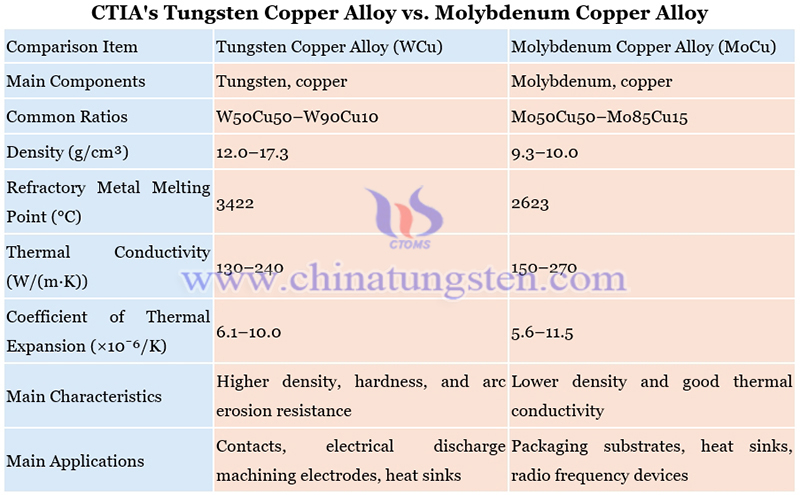
Tungsten has density of approximately 19.3 g/cm³, higher than molybdenum at approximately 10.2 g/cm³. As a result, tungsten copper alloy has significantly higher overall density than molybdenum copper alloy. Common tungsten copper alloys have densities of approximately 12.0–17.3 g/cm³, while molybdenum copper alloys typically range from 9.3–10.0 g/cm³. The higher density of tungsten copper alloy makes it suitable for compact electrical components and precision parts requiring high density. Molybdenum copper alloy is more suitable for electronic packaging applications where component weight needs to be controlled.
2. High-Temperature Performance Comparison: Tungsten Copper Alloy Offers Greater High-Temperature Resistance
Tungsten has melting point of approximately 3422°C, higher than molybdenum at approximately 2623°C. Tungsten copper alloy offers good high-temperature stability and can maintain structural integrity under elevated temperatures and arc exposure. Compared with molybdenum copper alloy, tungsten copper alloy is therefore more suitable for components exposed to high temperatures and electric arcs, such as high-voltage switch contacts, vacuum electrical contacts, and Electrical Discharge Machining (EDM) electrodes.
3. Mechanical Property Comparison: Tungsten Copper Alloy Generally Offers Higher Hardness and Wear Resistance
Tungsten itself possesses high hardness and strength, enabling tungsten copper alloy under appropriate material ratio and manufacturing process to typically demonstrate higher hardness and wear resistance. Compared with molybdenum copper alloy, tungsten copper alloy is better suited to withstand heavy contact pressure, mechanical load, and friction. Particularly, material with high tungsten ratio offers distinct advantage in hardness and wear resistance, suitable for heavy-duty electrical contact, wear-resistant electrode, and precision structural part.
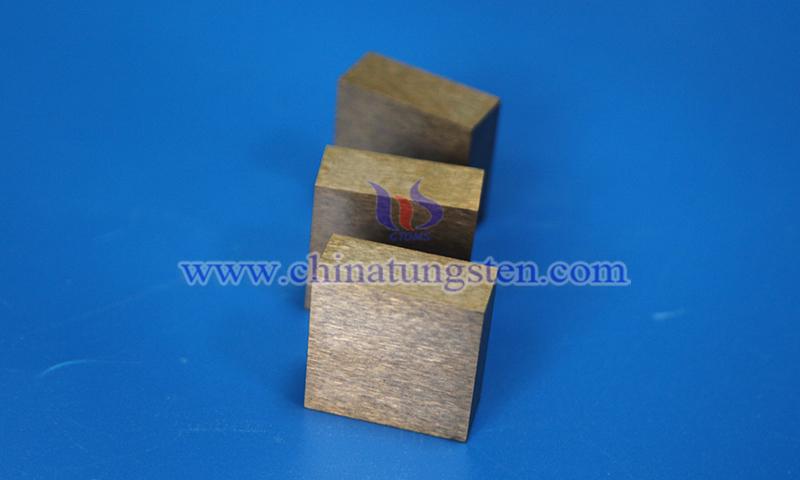
4. Thermal Conductivity Comparison: Some Molybdenum Copper Alloy Grades Offer Higher Thermal Conductivity
Both tungsten copper alloy and molybdenum copper alloy offer good thermal conductivity. Their actual thermal conductivity depends on material composition and manufacturing processes. Tungsten copper alloy typically has thermal conductivity of approximately 130–240 W/(m·K), while molybdenum copper alloy ranges from approximately 150–270 W/(m·K), with some molybdenum copper grades offering higher thermal conductivity. CTIA's tungsten copper alloy is suitable for components requiring a balance between thermal conductivity and mechanical strength. CTIA's molybdenum copper alloy offers advantages in certain high-thermal-conductivity electronic packaging applications.
5. Thermal Expansion Comparison: Both Alloys Have Adjustable Coefficients of Thermal Expansion
Tungsten copper alloy typically has coefficient of thermal expansion of approximately 6.1–10.0 × 10⁻⁶/K, while molybdenum copper alloy ranges from approximately 5.6–11.5 × 10⁻⁶/K. These ranges overlap. Both materials allow thermal expansion to be controlled by adjusting the ratio of refractory metal to copper, helping meet the thermal expansion requirements of different applications. Tungsten copper alloy and molybdenum copper alloy can both be used in electronic packaging structures involving chips and ceramic substrates. The specific material ratio should be determined according to the thermal expansion properties of adjacent materials.
6. Application Comparison: Tungsten Copper Alloy Focuses on Electrical Contacts, While Molybdenum Copper Alloy Is More Commonly Used in Electronic Packaging
CTIA's tungsten copper alloy is mainly used in high-voltage switch contacts, vacuum electrical contacts, EDM electrodes, conductive components, and electronic packaging heat sinks. It is particularly suitable for applications requiring high hardness, wear resistance, and arc erosion resistance. CTIA's molybdenum copper alloy is more commonly used in microelectronic packaging substrates, power module heat sinks, Radio Frequency (RF) and microwave devices, and precision thermal management components. It is suitable for applications requiring a combination of thermal conductivity, thermal expansion matching, and controlled component weight.
7. Performance Comparison of Tungsten Copper Alloy and Molybdenum Copper Alloy
The main differences between tungsten copper alloy and molybdenum copper alloy involve density, melting point, thermal conductivity, and mechanical properties. Their typical performance parameters are shown in the picture below:
CTIA GROUP has nearly 30 years of experience in tungsten copper alloy manufacturing, with extensive expertise in powder metallurgy and precision machining. CTIA provides tungsten copper alloy products in various ratios, including W50Cu50, W70Cu30, W75Cu25, W80Cu20, and W90Cu10, along with material selection, structural design, and precision machining to meet the material performance and dimensional accuracy requirements of power equipment, electronic packaging, electrical discharge machining, and high-temperature industrial equipment.
For any inquiry, please contact tungsten copper manufacturer: CTIA GROUP
Email: sales@chinatungsten.com
Tel: 0086 592 5129696 / 0086 592 5129595
Website: tungsten-copper.com
WeChat: